


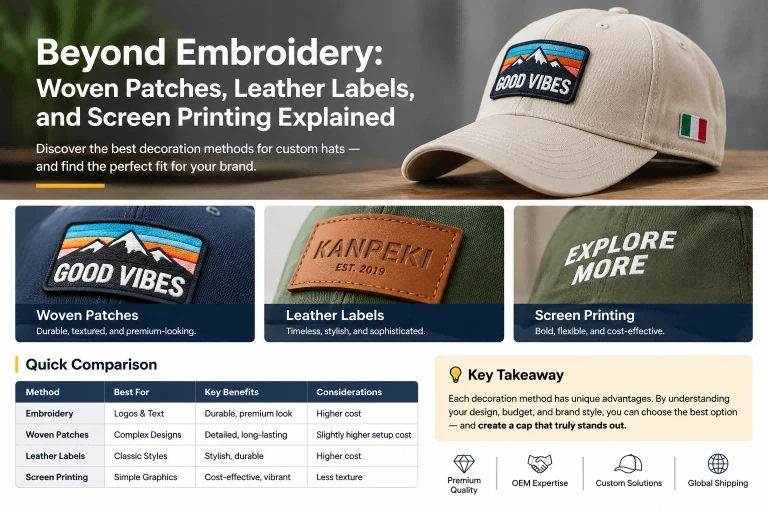
For years, embroidery has been the unquestioned standard for adding logos to hats. From simple sports caps to premium brand-name headwear, that classic raised thread effect has defined the industry. However, the world of hat manufacturing is evolving, driven by brands seeking more intricate designs, finer details, and unique branding options that truly stand out in a competitive market. As a leading Chinese OEM hat factory dedicated to global brands, Wanjia Hat Factory is helping clients push boundaries. This article will guide you through the exciting world beyond embroidery, diving deep into the technical advantages, best applications, and key differences of Woven Patches, Embroidered Appliqué Patches, and Screen Printing. By the end, you'll have the knowledge to select the perfect customization strategy to elevate your brand.
Key Takeaways:
- Woven Patches are unmatched for fine detail, small text, and a clean, durable finish, outperforming traditional embroidery on intricate logos.
- Embroidered Appliqué Patches provide an instant upscale, premium, and durable branding option, perfect for high-end fashion, heritage, and outdoor brands.
- Screen Printing offers unparalleled cost-effectiveness for mass production, allows for full-color or complex gradient prints, and can be applied creatively across the entire hat.
- Choosing the right technique depends on your brand positioning, target audience, budget, and design complexity. Wanjia Hat Factory provides expert OEM guidance to find the optimal solution.
- The global custom headwear market is growing, with a rising demand for personalized, sustainable, and high-quality branding beyond basic embroidery.
Understanding the Limits of Traditional Embroidery
Before exploring the alternatives, let's quickly review where embroidery shines and where it encounters limitations. Embroidery uses colored threads stitched directly onto the fabric or a patch. Its strengths are its durability and timeless appeal.
However, the size of a needle and the thickness of a thread limit its resolution. For small logos with tiny text, complex gradients, or intricate patterns, the stitches can look messy and lose definition. Large, solid-fill embroidered areas can make the hat heavy, affect its fit, and make the fabric pucker. This is where moving beyond embroidery becomes essential for premium brand building.
Woven Patches: The Masters of Detail and Refinement
If your design contains very small text, complex details, or delicate lines, traditional embroidery is not for you. Woven Patches are the definitive answer.
The Process: Precision at Every Thread
Unlike embroidery, where thread is stitched on top of a fabric base, Woven Patches are manufactured by weaving the design directly into a continuous piece of fabric using a specialized loom. Think of it like creating an entire piece of fabric that *is* your logo. This allows for far more detail and precision than even the best embroidery.
Top Advantages of Woven Patches
- Exceptional Detail and Precision: Because the warp and weft threads are so fine, they can replicate incredibly intricate graphics and text that are unachievable with stitching.
- A Sleek, Refined Look: The surface of a woven patch is smooth, clean, and flat, offering a modern, sophisticated aesthetic.
- Vibrant and Countless Colors: Since the design is woven into the patch itself, a wide range of colored threads can be used, and color gradients are easier to achieve (though still not perfect, they are vastly superior to embroidery).
- Durability and Softness: Woven patches are thin, lightweight, and incredibly durable. They don't have heavy stitching that can pucker, making them comfortable to wear. They are also highly resistant to fraying.
- Unlimited Shape Possibilities: Like embroidered patches, woven patches can be die-cut into any shape.
Best Applications for Woven Patches
Woven patches are the perfect choice for logos with fine detail. They are heavily used in technical sports gear, complex corporate logos, lifestyle brands, and any application where small, sharp text is critical. For instance, a brand focusing on high-tech hiking gear might use a woven patch to maintain a clean aesthetic while ensuring its detailed logo remains crisp.
Key Takeaway for Woven Patches: When your brand identity relies on a high-definition, professional logo with tiny text or intricate detail, **woven patches** deliver the most refined solution.
successful cases
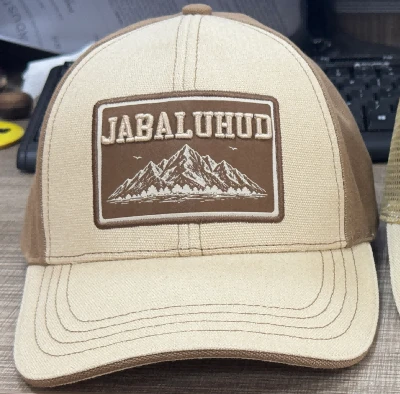
Woven Patches add 3D emboidery
Woven patches combined with 3D puff embroidery create a raised, textured effect, adding depth and dimension to custom cap logos while making the design more eye-catching.
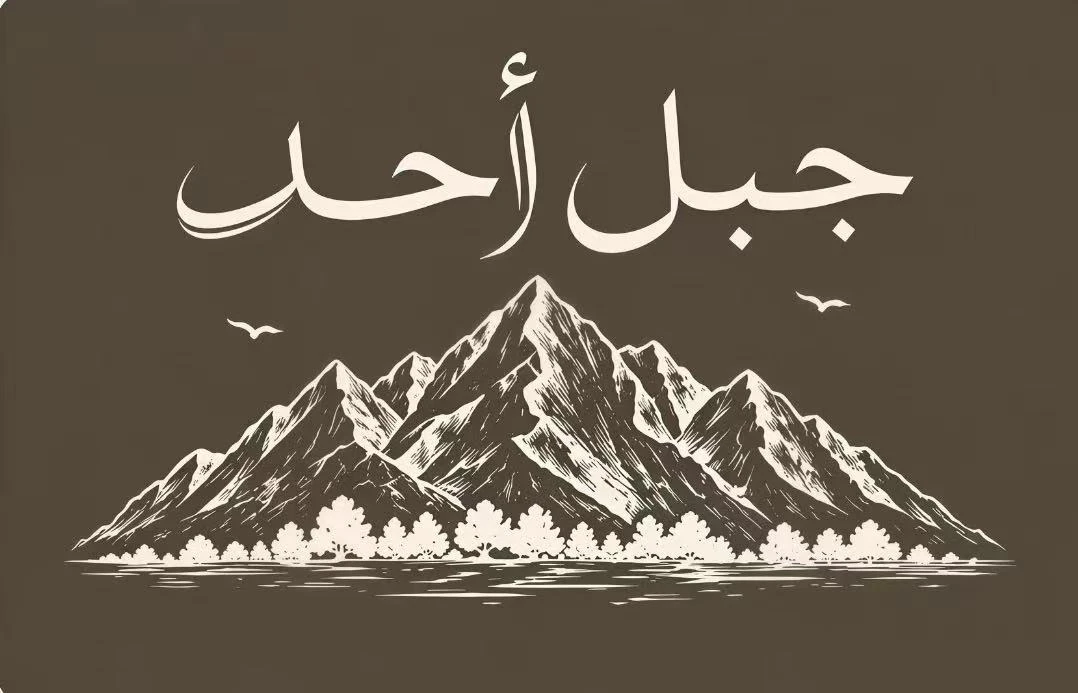
Design file
The original design artwork shows the logo layout, colors, lettering, and details, serving as a visual guide for accurate patch production.
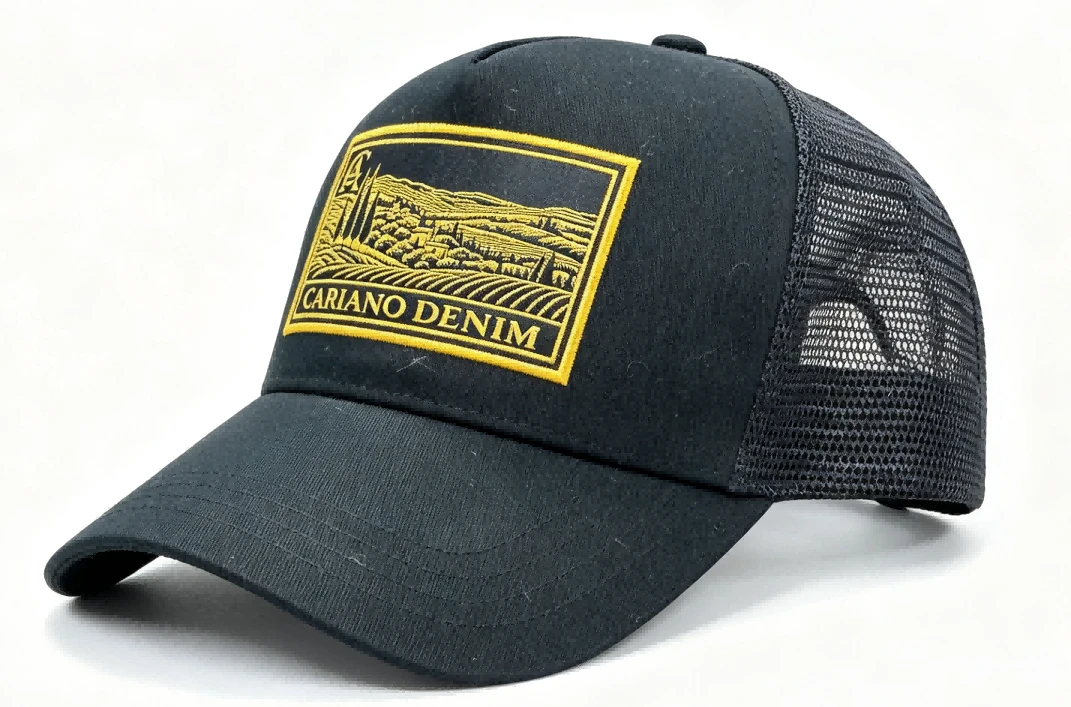
Woven Patches
A detailed gold-and-black woven patch featuring a scenic landscape and elegant brand lettering, creating a refined, high-contrast look on the black cap.
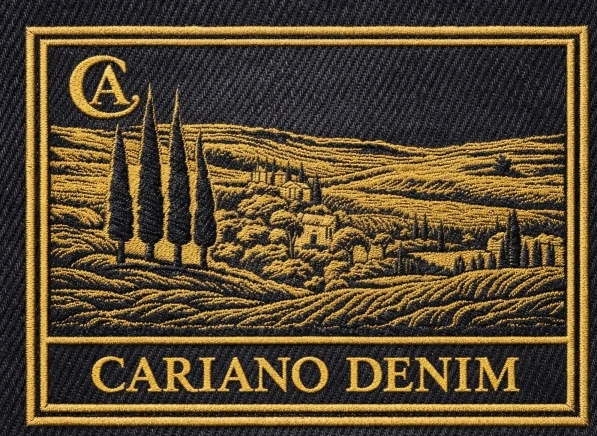
Logo Design
The original logo artwork combines a countryside landscape, a distinctive monogram, and classic typography, providing the visual reference for the woven patch production.
Embroidered Appliqué Patches: A Vintage and Textured Look for Custom Hats
Embroidered appliqué patches are a popular way to add character and visual depth to custom hats. Unlike direct embroidery, which stitches a logo directly onto the cap panel, an appliqué patch is embroidered on a separate piece of fabric and then attached to the cap.
This technique gives brands more flexibility in shape, size, color, and design. It is especially suitable for vintage-inspired caps, streetwear collections, and lifestyle headwear.
What Makes Embroidered Appliqué Patches Different?
An embroidered appliqué patch combines a fabric base with decorative embroidery. The design is created on the patch first, and the finished patch is then sewn onto the cap.
This allows brands to create larger and more detailed designs without placing all the embroidery directly on the cap panel.
Common design features include:
- Multi-color embroidery: Different thread colors can be used to create logos, lettering, symbols, and decorative details.
- Custom shapes: Patches can be made in rectangular, circular, shield, oval, or irregular shapes.
- Textured surfaces: Embroidery adds dimension and a tactile finish to the design.
- Decorative edges: Clean borders, merrowed edges, or intentionally frayed edges can create different visual styles.
Frayed-Edge Patches for a Vintage Look
One popular style is the frayed-edge appliqué patch.
Instead of using a perfectly finished border, the fabric edges are intentionally left with a slightly distressed or frayed appearance. This creates a worn-in, vintage look that works particularly well with washed cotton caps and casual streetwear designs.
As shown in the example, a large embroidered patch can combine bold lettering, multiple thread colors, and a distressed fabric edge to create a distinctive front-panel design.
This style is particularly suitable for:
- Vintage and retro-inspired cap collections
- Streetwear and casual fashion brands
- Outdoor and lifestyle headwear
- Caps with large front graphics or statement logos
The frayed effect should be controlled during development. The edges should look intentionally distressed rather than poorly finished. Buyers should confirm the desired amount of fraying through a physical sample.
An embroidered appliqué patch is a good choice when a brand wants more than a simple logo. It can become a key design feature that gives a cap its own identity.
successful cases
Choose the plan that suits you best.
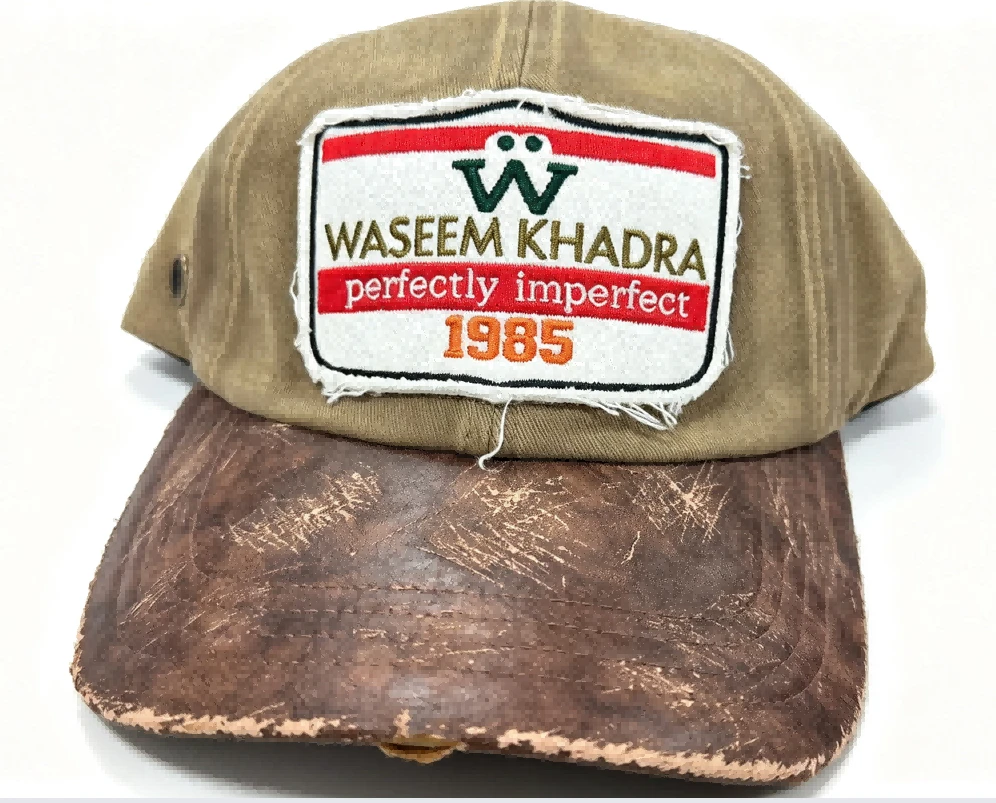
Embroidered Appliqué Patches
A vintage-inspired khaki cap featuring a bold embroidered appliqué patch, combining classic colors and distressed edges for a distinctive retro look.
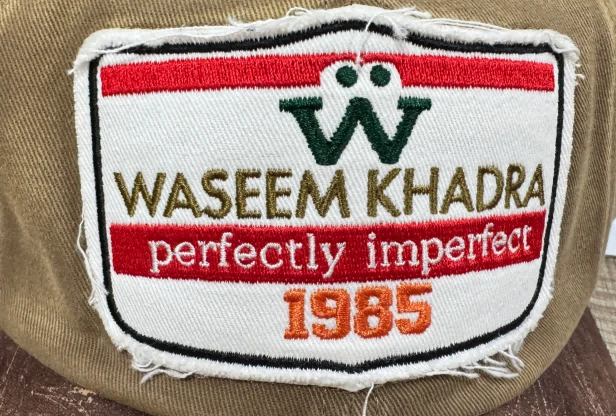
Detailed Instruction
The custom patch features a multi-color embroidered logo with bold lettering, contrasting stripes, and frayed edges, creating a unique vintage-inspired statement.
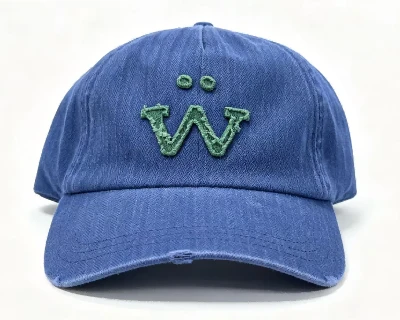
Embroidered Appliqué Patches
A custom cap featuring a textured green embroidered appliqué logo, creating a distinctive, rugged look against the denim fabric.
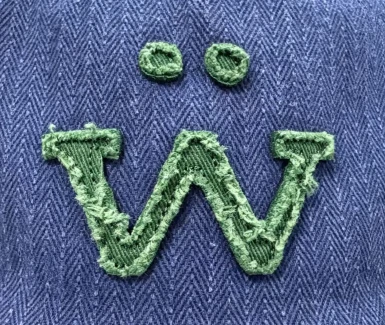
Detailed Instruction
The custom W-shaped logo patch features raised green embroidery and a textured finish, adding depth and a unique three-dimensional effect to the brand identity.
Screen Printing: The King of Mass Production and Creative Flexibility
When it comes to high-volume manufacturing, vibrant colors, and unparalleled creative freedom, **Screen Printing** remains a powerful tool in the custom hat world. While often associated with t-shirts, it is highly effective on hats when executed by an experienced **Chinese OEM hat factory** like Wanjia.
The Process: Laying Down Layers of Color
The core screen printing process is a standard one: a design is separated into colors, and each color gets a mesh screen. Ink is pressed through the screen onto the specific area of the hat. While simple on a flat shirt, printing on a curved hat surface requires specialized equipment and skill to prevent distortion.
Top Advantages of Screen Printing
Cost-Effectiveness at Scale:
Screen printing is the most economical method for large production runs. The initial setup cost per color is high, but the cost per unit plummets dramatically as quantity increases.
1
>>
Incredible Color Options and Gradients:
Since inks can be mixed and layered, you can achieve full-color designs, photorealistic prints, and complex gradients that are impossible with threads or woven methods.
2
>>
Unbeatable Design Flexibility:
You are not limited to a small square on the front of the hat. Screen printing can be done across seams, on the brim, on the side panels, and even on the underbrim, allowing for truly creative, all-over patterns.
3
>>
Wide Range of Specialty Inks:
We can use special inks like high-density/3D thick inks for a dimensional effect, reflective inks, metallic inks, or puff inks.
4
>>
Durable and Long-Lasting:
Modern screen printing inks are flexible, crack-resistant, and can withstand extensive washing and wear, especially when printed on synthetic fabrics like polyester.
5
5
5
successful cases
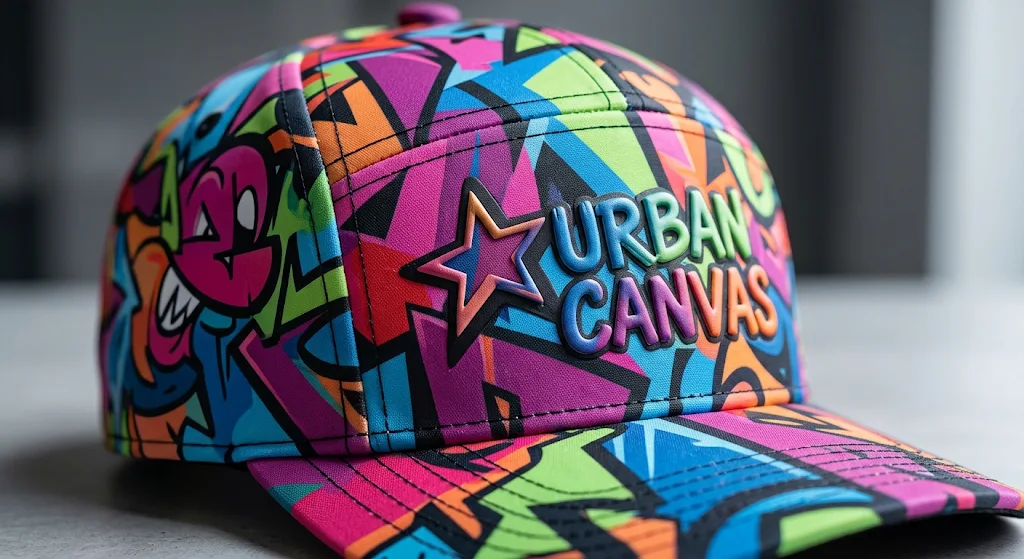
Screen Printing
A custom cap featuring a clean screen-printed design, delivering a smooth finish and vibrant colors that complement the cap's overall style.
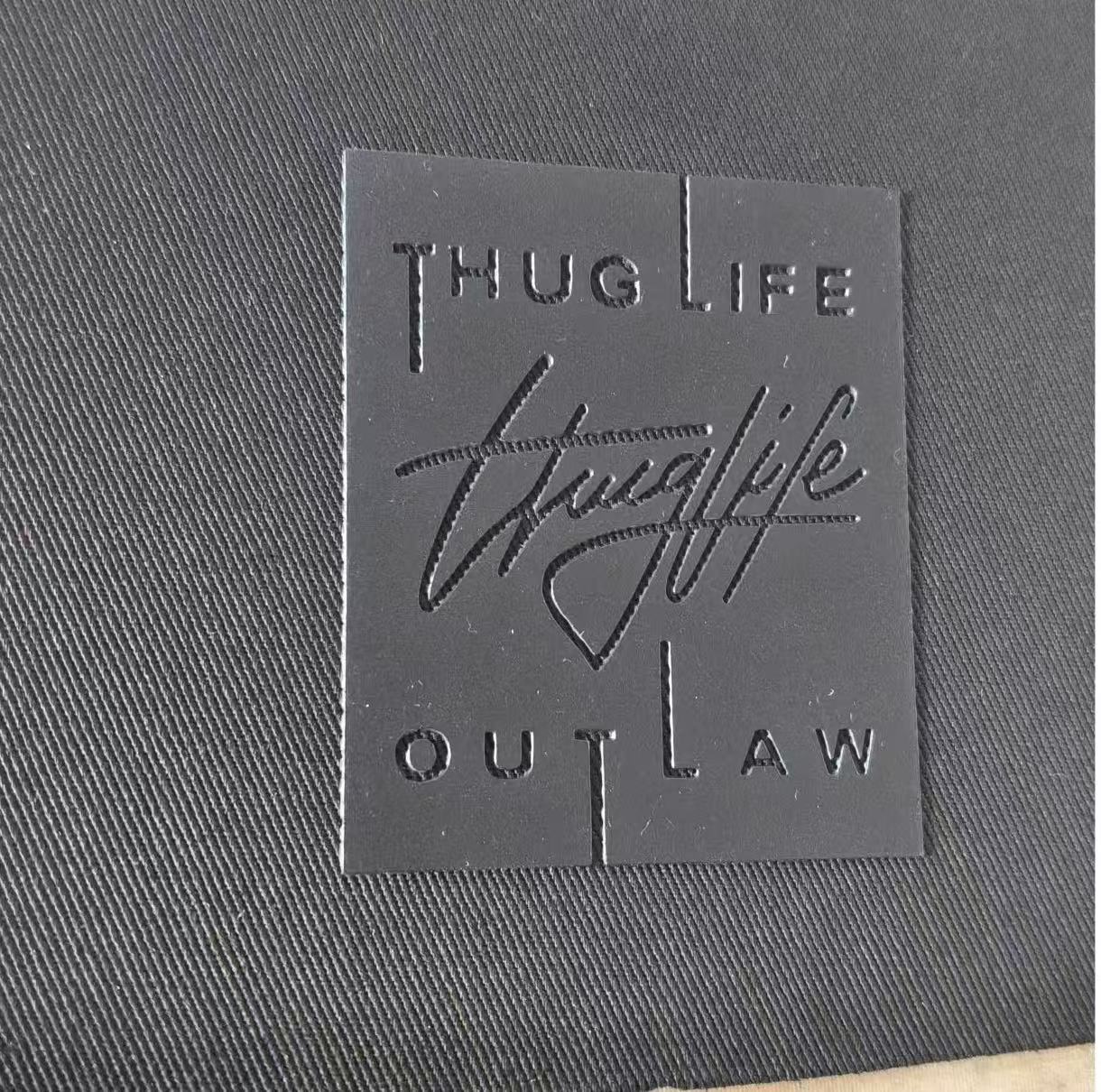
Detailed Instruction
The custom logo is screen-printed with sharp details and clear color definition, creating a smooth, lightweight finish while preserving the original artwork.
How to Choose the Right Decoration for Your Brand
Before deciding on a decoration method, consider these five questions.
1. How Complex Is Your Logo?
If your logo has tiny text or fine details, consider a woven patch.
If it has a simple shape or bold lettering, embroidery, leather debossing, or screen printing may be suitable.
If your artwork includes gradients or photographic effects, ask your manufacturer to evaluate printing alternatives. Standard embroidery cannot reproduce smooth color gradients in the same way as printed artwork.
2. What Is Your Brand Position?
Different decoration methods communicate different styles.
Streetwear: Woven patches, bold screen prints, and distinctive mixed techniques.
Outdoor brands: Leather-look labels and durable sewn patches.
Premium lifestyle: Subtle leather labels or clean woven branding.
Promotional products: Screen printing or simple embroidered logos.
These are design directions, not fixed rules. The cap material and overall construction still matter.
3. What Is Your Cap Fabric?
The same decoration method may look different on cotton twill, canvas, polyester, corduroy, and mesh.
For example, a textured fabric may affect the appearance of a screen print. A thick leather patch may also feel too heavy on a lightweight cap.
Always evaluate the decoration together with the actual fabric.
4. How Will the Cap Be Used?
A promotional giveaway, a fashion accessory, and an outdoor work cap may have very different performance requirements.
Think about exposure to sunlight, sweat, friction, cleaning, and frequent wear. These factors should guide the material and attachment choices.
A Practical Sampling Checklist for Cap Buyers
One of the most common sourcing mistakes is approving a decoration based only on a digital design.
A screen image cannot fully show the texture of a woven patch, the feel of a leather label, or the actual finish of a printed logo.
Before bulk production, use this checklist:
Artwork approval
Confirm the final logo file and dimensions.
Check spelling, colors, and proportions.
Confirm whether small details need adjustment.
Material approval
Confirm patch or label material.
Check the cap fabric and color.
Review the surface finish and thickness.
Position approval
Confirm front, side, or rear placement.
Check alignment with seams and panels.
Confirm the distance from the visor and other construction details.
Attachment approval
Check stitching or adhesive.
Inspect patch edges and corners.
Confirm that the decoration lies flat.
Wear and durability checks
Check for loose edges or threads.
Review print adhesion and curing.
Carry out suitable rub or wash tests based on the intended product use.
A signed-off sample gives both the buyer and manufacturer a clear production reference.
Ready to Develop Your Custom Caps?
Share your logo, cap specifications, and target quantity with our team. We'll review your requirements and help you explore the right decoration options for your project.
Working with an OEM Cap Manufacturer
Choosing the right decoration method is only one part of custom cap development. The manufacturer must also understand the cap construction, fabric, artwork, and production sequence.
At Dongguan Shipai Wanjia Hat Factory Co., Ltd., we focus on OEM and ODM custom headwear for overseas brands, wholesalers, and business buyers.
When preparing a custom cap project, buyers should provide:
Cap style or reference photos
Fabric preference and color
Logo artwork in a production-ready format
Decoration method or preferred visual reference
Logo size and placement
Target order quantity
Our team can review the requirements and assess suitable decoration options for the project. Some details may need a physical sample to confirm the final result before bulk production.
Whether you are developing a classic baseball cap, a trucker hat, a dad hat, or a five-panel cap, the right branding method can make a meaningful difference to the finished product.
A good custom cap is not just about putting a logo on fabric. It is about choosing the right combination of material, construction, and decoration to represent your brand.
FAQ
Q: 1. What is the minimum order quantity (MOQ) for custom Woven Patches or Leather Labels?
A: While it varies slightly, typically it's around 100 pcs per design for custom patches or labels, and 100-300 pieces for a complete custom hat project. Please contact us for a specific quote based on your needs.
Q: 2. What kind of design files do you require for Screen Printing, Woven Patches, or Laser Engraving?
A: We require high-resolution, vector-based design files, ideally in Adobe Illustrator (.AI), .EPS, or .PDF formats. Make sure all fonts are outlined. This ensures the best clarity for production.
Q: 3. How long does the sampling and production process take?
A: Generally, the sampling process takes about 5-7 working days, some processes involving mold making will take longer.. Once the sample is approved, mass production typically takes 25-30days. Shipping time depends on your location and chosen shipping method. We will provide a detailed timeline during the quote phase.
Q: 4. Can you use real leather for my Leather Labels?
A: Yes, we offer various options for Leather Labels, including high-quality genuine leather, split leather, suede, and premium synthetic leather (Faux/PU). We will help you select the material that best matches your budget and brand vision.
Q: 5. Do you offer a quality guarantee for your OEM products?
A: Absolutely. At Wanjia Hat Factory, we are committed to quality. We have a multi-step quality control process. Every hat is inspected before shipping. If you find a defect in materials or workmanship that is a result of our production, we will work with you to find a satisfactory solution.