

Many people have a similar experience when buying baseball caps: when they first get them, the cap has a three-dimensional shape and a clear outline, but after wearing it for a while, the crown gradually collapses, and the brim no longer maintains its original curve, making the whole cap look loose and lifeless.
Baseball caps are prone to deformation, which is often not determined by a single factor, but rather by the combined effect of the cap's internal structure, the materials used, and how it is worn, cleaned, and stored.
1. Crown collapse: The key lies in the internal structure
In daily observation, many users judge the support of the cap by touching its surface, but in reality, what truly determines the stability of the crown is the structural design hidden inside the fabric.
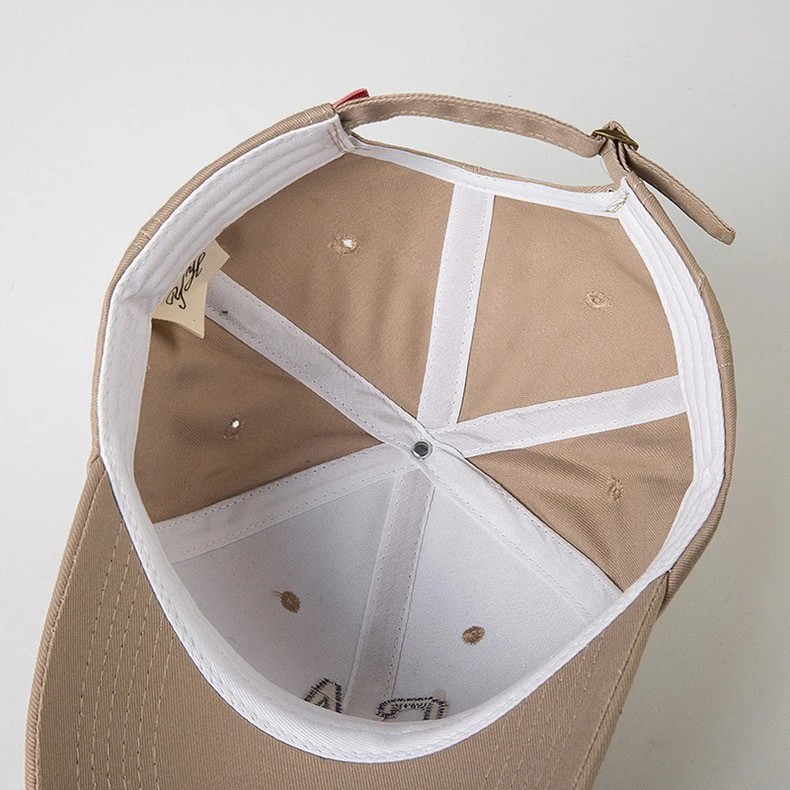
Some baseball caps, in pursuit of lightness and softness, reduce or eliminate the inner lining of the crown. While this design is indeed more comfortable in the initial stages of wear, over time, the crown will gradually lose its support due to repeated stress, eventually leading to collapse.
In contrast, crowns with shaping interlining or reinforced structures, although slightly stiffer to the touch, can maintain their original shape even after being worn, taken off, and subjected to slight compression.
2. Brim deformation: Stemming from unconscious actions during use
Unlike the crown, brim deformation is more often caused by usage habits than by the length of time worn.
In real life, many people are accustomed to grabbing the brim with one hand to take off their hats, or casually stuffing their hats into bags when not wearing them. These actions cause the brim to bear continuous and concentrated pressure in localized areas.
If the brim uses a thinner shaping material internally, then after repeated pressure, the internal structure is prone to shifting or fatigue, leading to uneven bending, softening, or even warping of the brim.
3. Improper cleaning methods
Many users find that their hats remain in good condition during wear, but after one cleaning, the overall shape changes significantly.
This is because in a damp state, the fabric and internal structure of the cap become softer. If the cap is pulled, twisted, or spun at high speed at this time, it is very easy to cause permanent deformation. Especially when washing in a washing machine or soaking in hot water, the combined effects of mechanical force and temperature are amplified, forcing the crown and brim to change shape before they are properly formed.
4. Incorrect Storage
When a hat is constantly pressed down by other objects or multiple hats are stacked haphazardly, the crown and brim gradually adapt to this stress, eventually resulting in permanent deformation.
This change happens slowly and is therefore easily overlooked, but by the time the hat is worn again, its three-dimensional shape has noticeably deteriorated.
Proper storage methods should minimize continuous pressure and maintain sufficient support space inside the crown.
5. Material Selection
The differences in deformation resistance among different fabrics are often underestimated by ordinary users.
Pure cotton fabrics perform well in terms of comfort and breathability, but are more prone to shape changes after prolonged exposure to moisture or pressure, while blended or high-density synthetic fabrics generally exhibit better structural stability.
Understanding these differences helps users make more appropriate choices based on their usage scenarios.
Baseball cap deformation is not simply a quality issue, but rather the result of the long-term interplay of structural design, material characteristics, and usage methods.
When users understand these factors and pay attention to them in daily wear, washing, and storage, even baseball caps worn frequently can maintain a good appearance and shape for a longer period.